 As Alexander Pope originally opined in 1711, “to err is human; to forgive, divine.” Of course, I am keenly aware of the irony of publicly-declared Atheist aspiring to (or even referring to) divinity but indulge me a moment longer if you will (NOTE: For those that won’t, feel free to check out Pope’s epic work: An Essay on Criticism, he’s far more erudite than I am). Nevertheless, Pope’s reference to divinity is arguably secular – inasmuch as it provides an aspirational moral position rather than suborning the supernatural, one where an individual’s humanity might be (momentarily) transcended by forgiving the errors implicit in the human condition. Further, it is hard to find anyone who opposes the moral value of, or even imagine a higher ideal to aspire to than, forgiveness. Who of us hasn’t marveled when the loved ones of a victim of violent crime publicly state that they forgive the perpetrator? What’s more, who hasn’t felt the waves of benevolence and peace when forgiving what you previously thought to be unforgivable?
Unfortunately, forgiveness has fallen into modern disfavor. The storied moral high ground once exclusively occupied by absolution now accommodates an imagined moral “consistency” instead. The greatest ideal to which thought leaders now aspire is to have lived consistently with the same set of convictions that you have now since time immemorial (or at least since the age of reason); with absolutely no inconsistent statements or actions in your past – no matter how distant. I submit to you, that this is insane.
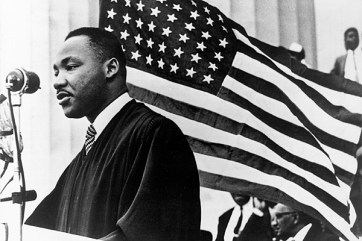
The greatest human aspiration has been, is, and always should be to grow. If we’re lucky, we’ll get eight decades or so on this beautiful rock. That’s it. No matter what you believe happens after, you know that you’re not going to get another go as you. What makes us human is our big, beautiful brains – and the abilities they give us, to learn, to adapt, to improve. We improve on all different scales: from day-to-day, year-to-year, generation-to-generation and so on. Of course, this improvement is not as consistent as it may appear in hindsight. Our progress often requires that we take a step back in order to take a step forward. In some cases, we go charging back so forcefully that it appears we might be changing directions, altogether. But a little perspective always demonstrates the implicit truth of President Obama’s favorite Martin Luther King Jr. quote – especially important today: “The arc of the moral universe is long, but it bends toward justice.”
The most common criticism of that sentiment is an important caveat – that these things do not happen by magic. We must work to grow, and that can start with the work required to forgive. I was moved, most recently, by the recent story regarding Kevin Hart, and more locally by the candidacy of Congressman Ruben Kihuen for Las Vegas City Council. For those that don’t know, about ten years ago (circa 2010), well-known comedian, Kevin Hart, regularly posted (via Twitter and other social media) grossly homophobic sentiments as humor. He doesn’t tell those jokes anymore, because he shouldn’t, they’re not funny, and from what I can tell, he’s grown. Further, he’s apologized, but none of that was enough for the Internet. Within 48 hours of the hosting announcement, he stepped down from his hosting duties rather than bow to ongoing pressure to continue to apologize. Congressman Kihuen was the subject of sexual harassment allegations from multiple women, amidst a flurry of similar allegations made against dozens of elected officials prompting investigations, resignations and a party-wide reckoning (at least for one of the major political parties). He almost immediately apologized, denied the most serious allegations, announced he wouldn’t seek re-election and the “mob” moved on – having obtained the proverbial “scalp” they sought. Despite the fact that Ruben was at the time (and still is) a single man, and his public soul-searching, he was “branded,” thrown in with the lot of rapists and sexual aggressors and the balance of his public service career left for dead.
To be clear, I am wholeheartedly in support of the #MeToo movement and their previously unthinkable takedowns of Bill Cosby, Harvey Weinstein, Matt Lauer, Bill O’Reilly and more. It was long overdue and just in its goals and its gains. But like anything else, too much of a good thing can quickly turn not-so-good. Public figures, while largely “owned” by the public, are not similarly obligated to each member of that public. Everyone is not entitled to an apology – no matter how rightfully offended they might be. Mistakes in judgment, no matter how egregious they might seem in the harsh light of hindsight, cannot obligate someone to endless shame and atonement – especially at the bequest of “victims” whose connection to the wrongful conduct consists exclusively of following via social media. This does not minimize the very real impact that may be visited upon these individuals – but it does minimize the culpability of the accused. Put simply, just because Kevin Hart and Congressman Kihuen did something bad, doesn’t mean they did it to you just because you’re impacted by it.
More importantly, if we are not willing to forgive these past sins and let these individuals grow, then the proverbial “sentence” for any crime of moral turpitude is necessarily death. I know that sounds extreme. It should. But, if we refuse to let people rise above the aggregate of their past sins, then aren’t we essentially condemning them? This modern condemnation is made possible by nearly unlimited and wildly inexpensive digital storage, combined with our seemingly endless appetite for self-indulgence – which has resulted in the vast majority of us voluntarily publicizing most of our previously private lives. It’s hard to find a more universally beloved human pastime than passing judgment on the lives of others, and in our relentless pursuit of convenience, we’ve even outsourced this banality – content to let others pass judgment for us, so we can enjoy all the prurient schadenfreude, with none of the associated guilt. Unfortunately, this commoditized version must satiate the greatest number to survive, and as a result, quickly becomes indiscriminate and destructive. There is simply always someone to be offended – no matter how benign your activity or your associated intent. In reality, there are no perfect people – and the fact that we have come to expect such perfection as the standard for those looking to come back from mistakes – is as disturbing as it is disappointing.
So, what is the relevant standard? For me, it’s a matter of genuine contrition. While this can be evident in words, it is most effectively communicated in deeds, and most commonly evidenced by time. To be clear, the simple passage of time does little to mitigate past sins. Just because they loom less large or that my personal concern has diminished in the face of other things to be concerned and/or outraged about, doesn’t mean they are forgiven. But when combined with public apology, reasonable explanation/accountability and the passage of time without incident – or even more importantly – with remedial action, education and/or growth – there appears to be more than adequate opportunity to forgive. After all, if we expect an opportunity to grow and move beyond our own past transgressions, how can we hold others to a different standard? To do so is the apex of hypocrisy – and something we ought to avoid by any means.
Forgiveness isn’t easy. It shouldn’t be. Our long and contextual memory is the source of much, if not all, of our humanity. It allows us to understand this world like no other living creature(s). But with this great power comes the responsibility to learn how to use it for the greatest good. It’s fine to never forget – but as associated failure to ever forgive is an abuse of this extraordinary capacity. I remain a fan of Kevin Hart, and I hope he will get the chance to host the Oscars, or other important awards show. Of course, there’s no way for me to know what’s in his heart, but after nearly three years of exposure to actual bigots – I feel like I’ve got a pretty good sense of who’s just going through the proverbial motions. What’s more, I’m supporting Ruben Kihuen for Las Vegas City Council. Having had the opportunity to sit and speak with him, personally, and at great length, I’m quite convinced that he learned from what happened to him, and that he’ll treat his second chance with even greater conviction and resolve than he did his first. I’ve made mistakes of my own, most of them private but many of them quite public. For those who have forgiven me and given me the opportunity to remake and rebuild myself, I am eternally indebted and grateful. And for those who haven’t, I remember who they are, too – they constitute my mental mailing list for the notice of each accomplishment since they left me for dead.
Of course, as an Atheist, I don’t believe in a judgement day, where my life is comprehensively called to account, and if the balance is more “good” than “evil,” then I will be granted heaven over hell. But I do believe in morality, accountability and the words of the man whose life we celebrate today when he said: “Darkness cannot drive out darkness; only light can do that. Hate cannot drive out hate; only love can do that.” For there is no greater love than to forgive, and no greater divinity available to us than that.
 Says Tru